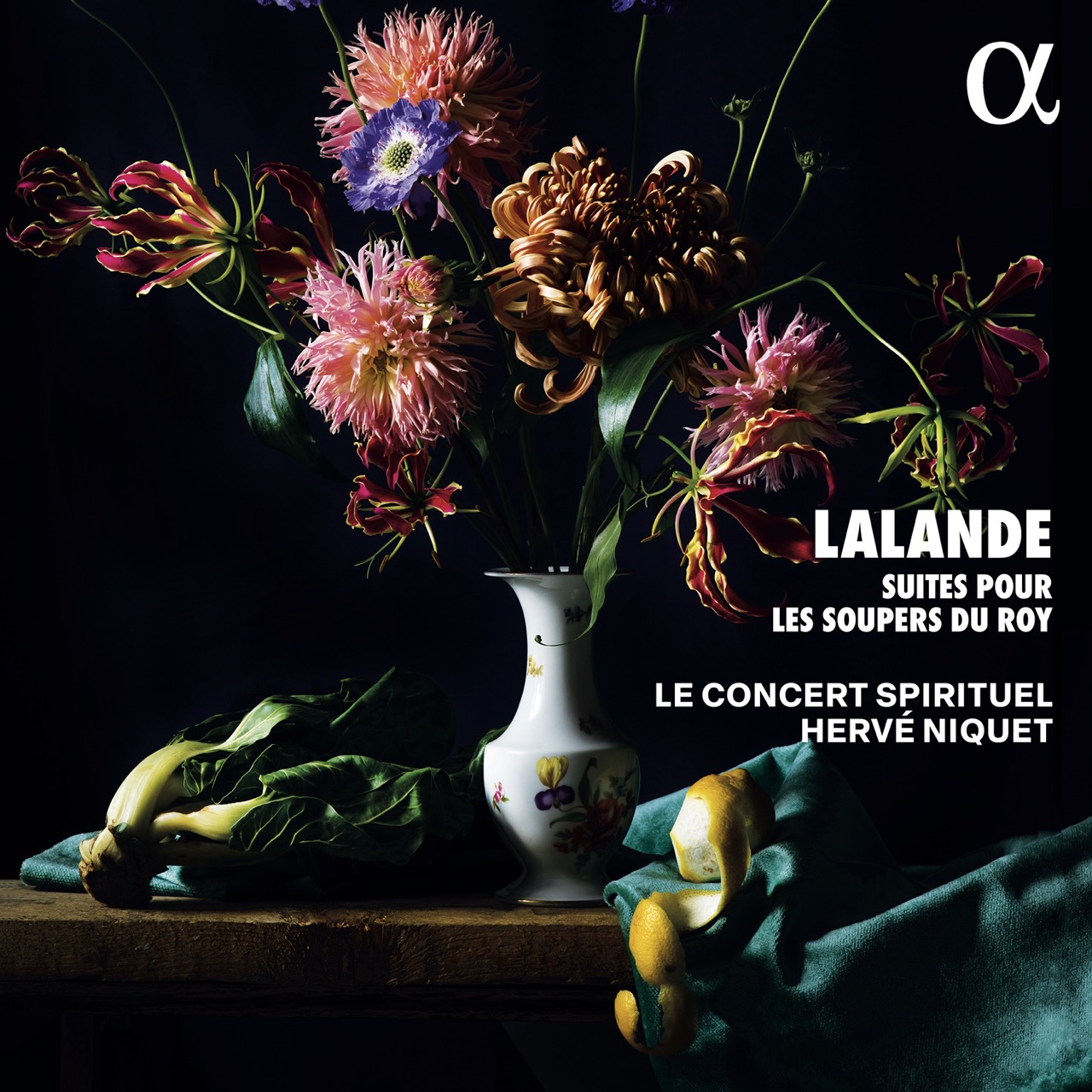
Suites for the King's Suppers | Lalande
For the tercentenary of Lalande's death, Le Concert Spirituel and Hervé Niquet imagine a rehearsal at the composer's own home on the eve of a royal supper. 32 tracks, 60 minutes, featuring flamboyant suites, virtuosic caprices, and an epilogue as delightful as it is irreverent.
Information
Label: Alpha Classics (Ref. ALPHA1272)
Release date: October 2, 2026 (CD and digital platforms)
Format: 32 tracks
Duration: 60'07
Recording: April 2025, TAP – Scène nationale de Grand Poitiers
Distribution
Hervé Niquet conductor
Le Concert Spirituel orchestra
Jean-Philippe Desrousseaux narration
In 1726, Michel-Richard de Lalande, Superintendent of the King's Music, passed away. Three centuries later, Hervé Niquet and Le Concert Spirituel give him a voice once more with a recording that does more than just commemorate: it brings him to life, revealing Lalande as a composer of flamboyant symphonies.
Rather than recreating the musical program of a Grand Couvert at Versailles, Hervé Niquet flips the perspective. He imagines the behind-the-scenes: one evening, at Lalande's home, a few musicians familiar with chamber music gather to rehearse and rearrange the suites intended for the King's next supper. Massialot, the composer's cook and butler, comes and goes, bringing food and drink while reading aloud the letters and gazettes that have just arrived by mail coach.
The meal—and the album—conclude with three tracks that serve as dessert: a colorful letter from the Princess Palatine, sister-in-law to Louis XIV (track 30); a drinking song from 1683, Why should we drink water? (track 31); and the show's Cotillon, mischievously subtitled Pâté en croûte and old gossip (track 32), which, as its name suggests, truly brings the album to a close.
"In the aristocratic France of the late 17th and early 18th centuries, the most exquisite refinement sits comfortably alongside the most unabashed triviality," summarizes specialist Françoise Rubellin (University of Nantes), who wrote a booklet essay on this world of courtiers where bawdiness blends seamlessly with grand ceremony.
The result is a Versailles that feels less rigid, more fluid, and almost domestic, where music is no longer just the garb of power but once again a shared pleasure—a living "sound laboratory," in the words of musicologist Thomas Leconte (Centre de musique baroque de Versailles), author of the album's liner notes.
Lalande, architect of sound
Beyond its theatrical inventiveness, the album primarily offers a musicological proposition. The Sinphonies pour les Soupers du Roy are not a static work: they consist of hundreds of pages constantly recomposed over several decades, retouched according to the reigns, circumstances, and tastes of the court, drawing heavily from earlier entertainments (Ballet des Fées, L'Hymen champêtre, Ballet de la Paix, ballets from L'Inconnu and Cardenio). Le Concert Spirituel offers a journey through them that reveals the internal logic of this shifting heritage—even in the very architecture of the disc, such as the "Millefeuille" composed from four different suites (11th, 13th, 14th, and 15th).
The centerpiece of this reinterpretation is the Third Caprice, the only work in the program presented in its complete five-part orchestral scoring. Its inner voices, which had been lost from the original sources, were reconstructed specifically for this recording by Thomas Leconte. It features one of Lalande’s most daring inventions: long "recitatives" assigned solely to the bassoon, emerging from the orchestral texture like voices from opera or the organ tradition. The instrumentation itself tells a story: originally conceived for the "Petits Violons" ensemble, which was disbanded in 1715, these pieces later circulated in smaller formations. Le Concert Spirituel restores this flexibility here, alternating between full orchestral passages and more intimate chamber episodes.
"The King’s Superintendent of Music, renowned for his sacred music and numerous entertainments, was also a remarkable composer of symphonies." — Hervé Niquet
"The most exquisite refinement sits unselfconsciously alongside the most unabashedly trivial." — Françoise Rubellin, University of Nantes
"Lalande’s Symphonies appear less like a static monument and more like a substance in perpetual transformation." — Thomas Leconte, Centre de musique baroque de Versailles

